← All work
Editorial ScrollytellingIn developmentIndependent research & media organization

Twenty-nine state-backed enterprises now sit between Africa's mines and the world's batteries.

A long-form scrollytelling investigation into how Chinese state-backed and hybrid enterprises came to dominate Africa's critical minerals supply chain — built to be read as a story and interrogated as a dataset.

View the live producttm-mining-giants.vercel.app
PERIODIC TABLE · TRANSITION MINERALS1Li2C3Ni4Co5Mn6Cu7Nd8Dy9Pt10Ta11Sn12Fe
29 companies38 projects6 African countries11 transition mineralsESG record 2005–2023In development

The challenge

The energy transition runs on a short list of minerals, and the companies mining them in Africa answer, ultimately, to Beijing. That is the finding. The difficulty is that it lives in fragmented registries, ownership disclosures, and a decade of ESG filings — evidence that persuades a policy audience only when it is assembled and traceable. A static report flattens it; a raw database excludes everyone who is not already an analyst. The client needed both at once.

The approach

VizStats built a single scroll-driven narrative that resolves at two altitudes. A generalist reader follows the argument top to bottom — machines, minerals, money, companies, command, consequences — while every visualization underneath stays filterable for a specialist interrogating the data directly. The structure is the argument: energy history establishes stakes, the mineral layer defines the prize, the investment gap and company registry name the actors, the command chain proves who controls them, and the incident timeline records the cost. Nothing is asserted that the reader cannot inspect.

The claim that these mines answer to Beijing is not asserted in a sentence — it is a chart the reader can climb, one link at a time, from an African pit to the State Council.

01

An argument built in six movements

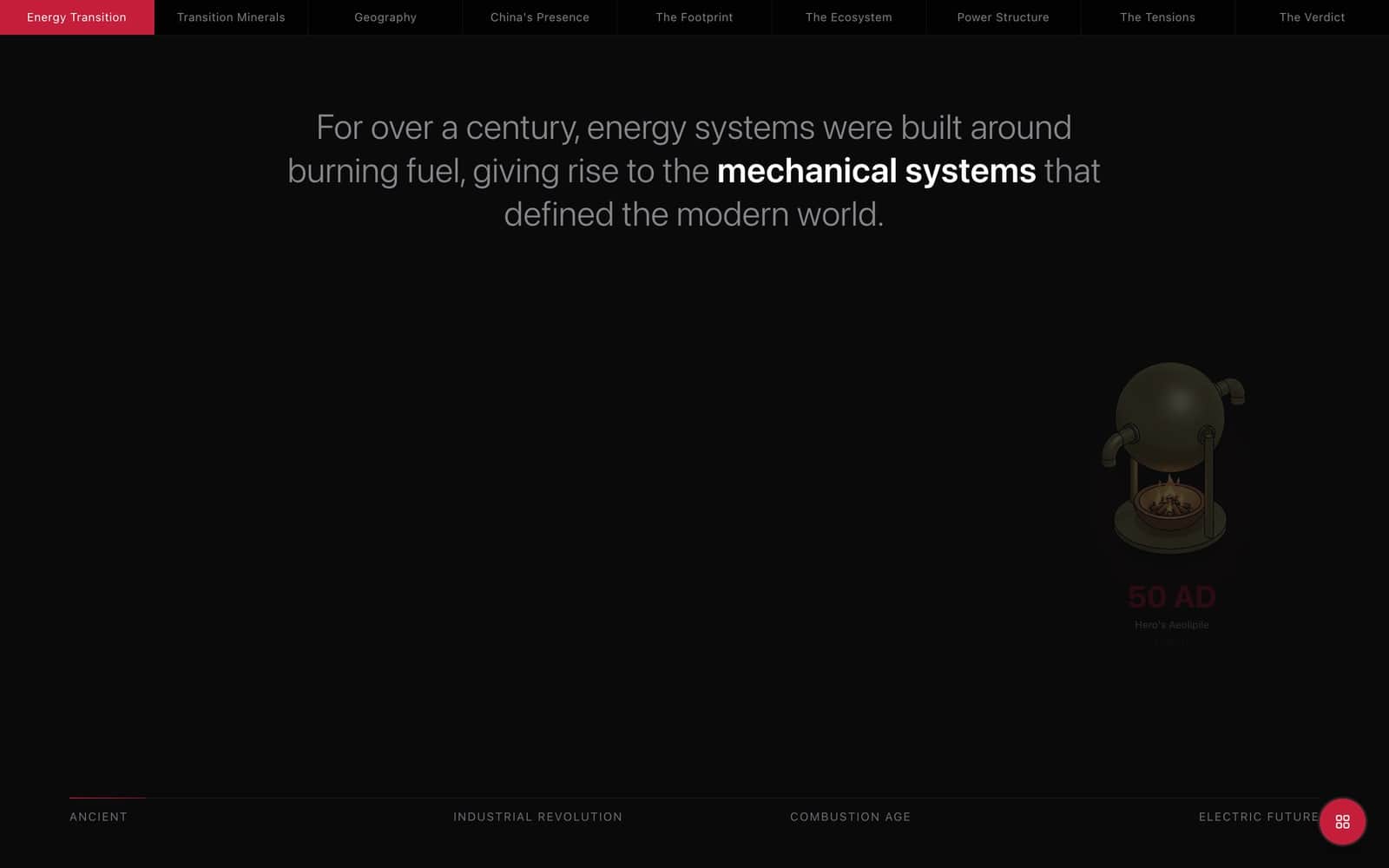
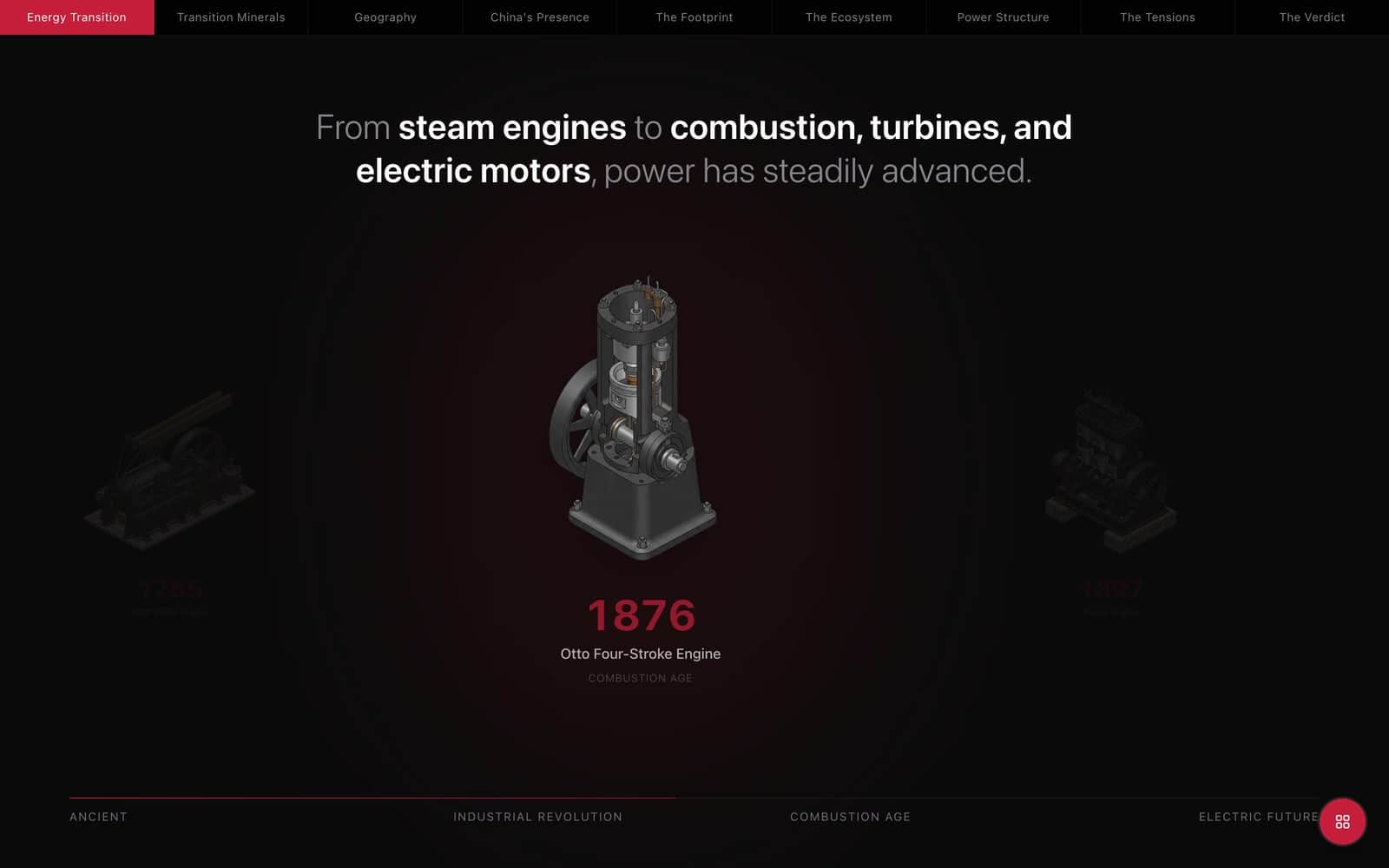
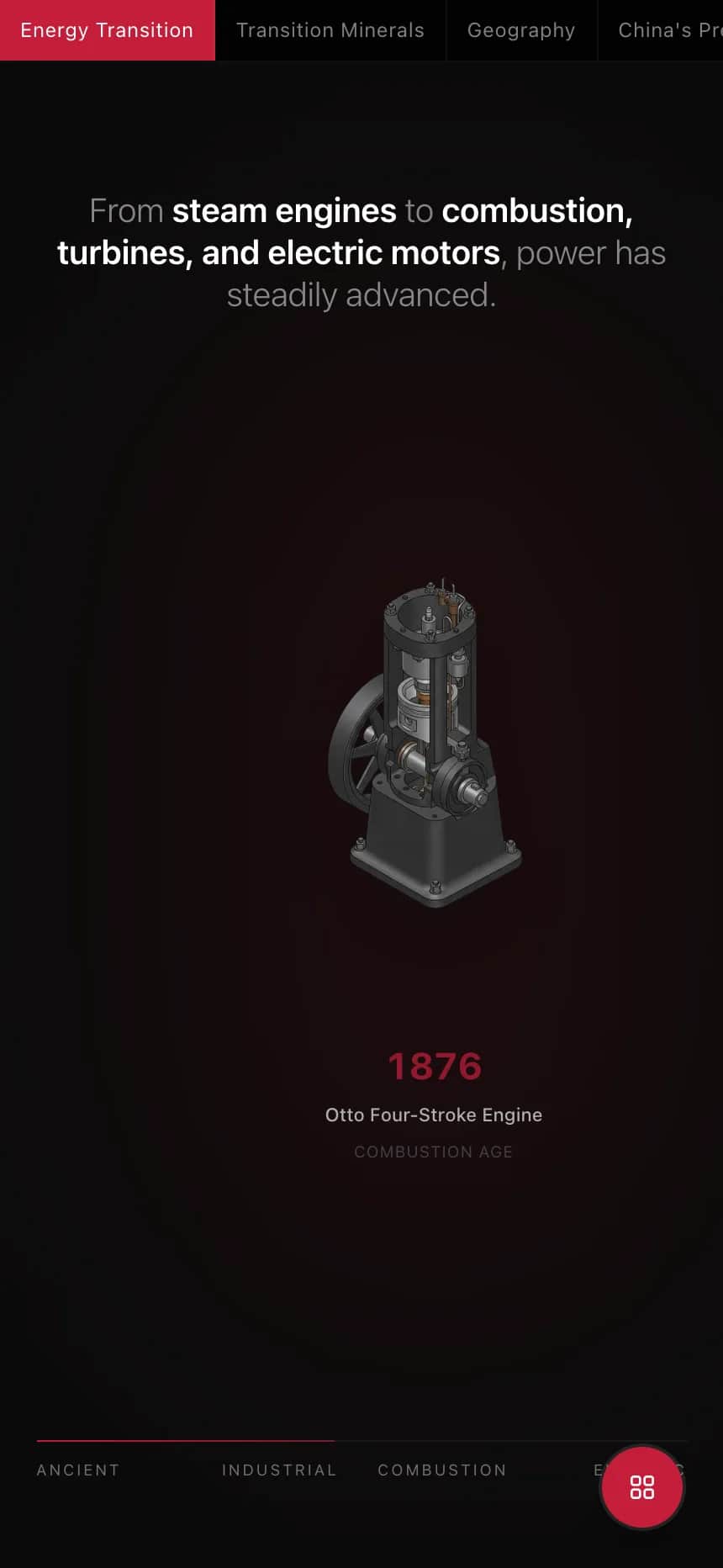
The investigation opens with a kinetic timeline of energy machines — from Hero's Aeolipile in 50 AD to the lithium-ion battery — placing the present scramble inside two thousand years of energy history rather than treating it as breaking news. From there the narrative descends through an interactive periodic table of transition minerals: lithium, graphite, nickel, cobalt, manganese, copper, and the rare earths that make the modern battery and grid possible. Each movement narrows the frame. History sets the stakes, chemistry defines the prize, and the reader arrives at the central question — who controls the supply — already understanding why it matters. The sequence is engineered so the story reads cleanly at a scroll, before any reader chooses to stop and interrogate the data beneath it.

02

The registry, and the chain of command above it

At the center sit two linked structures. A live registry catalogues all 29 enterprises, classified by ownership: central SOEs, provincial SOEs, hybrid firms, and special strategic vehicles — distinctions that determine who a company actually answers to. Above it, a command-chain org chart traces the relationships upward from African mine sites through corporate parents to Beijing's State Council and SASAC. This is the load-bearing claim of the whole investigation, and it is shown, not stated: the reader can follow a single mine from the ground in Africa to the ministry that governs its owner. A comparative investment visualization frames the stakes in capital — roughly four billion dollars of Western commitment against more than fifteen billion in Chinese — making the imbalance legible before the structural detail explains how it was built.

03

Partnerships, and the record of consequences

Control is never exercised alone. A geopolitical partnership network map plots the web around these enterprises — African state partners, Western partners, strategic investors, and the policy banks that finance the deals — so the reader can see which governments and lenders the supply chain depends on. Against that map of alliances runs its counterweight: a documented ESG incident timeline spanning 2005 to 2023. It is the accountability layer of the investigation, holding the record of what dominance has cost on the ground alongside the diagram of how it was assembled. The two read together — ambition and consequence on the same page — which is precisely the tension a policy audience needs to weigh, and precisely what a press release omits.

04

One narrative, two readers, no compromise

The design problem was refusing to choose an audience. Most investigations pick one — a polished story that a specialist finds thin, or a dense tool a general reader abandons. This build serves both from a single scroll. The narrative carries anyone through the argument in order; underneath, every layer — the mineral table, the company registry, the network map, the incident timeline — stays filterable for an analyst who wants to test a specific country, mineral, owner, or year. The generalist is never slowed by controls they do not need; the specialist is never handed a story with the evidence stripped out. Currently in development, the product spans 29 companies, 38 projects, 6 African countries, and 11 minerals — held in one coherent experience rather than split across a report and a spreadsheet.

Why it matters

The investigation gives the client a single place to make — and prove — a claim that usually dies in fragmented filings: that Africa's critical-minerals supply chain runs upward to the Chinese state. Because every layer is documented and filterable, a policy analyst can interrogate the ownership of a specific company, the incidents at a specific site, or the financing behind a specific deal, while a general reader follows the same evidence as a story. It turns scattered registries, investment figures, and a decade of ESG records into research infrastructure a newsroom can stand behind and return to as the data grows.