Chinese mining in Africa, resolved to the project level and made searchable.
A project-level intelligence database of Chinese-operated and Chinese-invested mining across Africa, built for the researchers, journalists, and policymakers who return to it.
The challenge
Chinese mining involvement across Africa is documented in fragments — scattered across filings, press releases, and country-specific reporting, rarely at the project level and almost never in a form that lets a researcher compare across borders. A reporter tracing cobalt in the DRC and a policy analyst mapping ownership across Zambia and Zimbabwe were starting from raw material every time. The task was to turn that scatter into a single reference tool with enough depth to withstand professional scrutiny and enough structure to answer questions its makers hadn't anticipated.
The approach
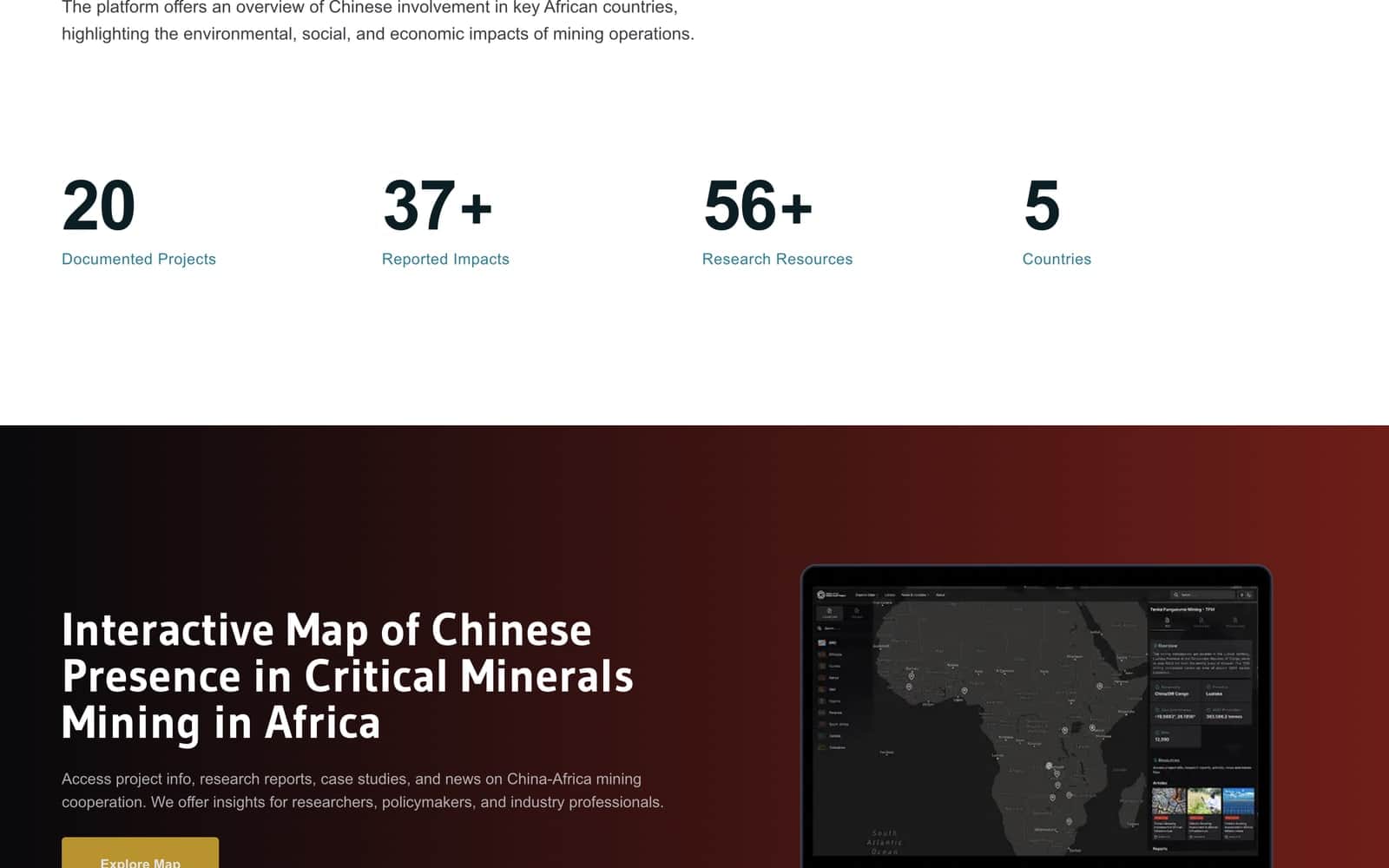
We built a research database, not a dashboard — every field structured for querying rather than reading, so a journalist can move from a mineral to a company to a project's ESG record in a few steps. Twenty-plus active projects across five countries were normalized into a consistent schema covering ownership history, operational status, mineral type, ESG impact flags, and company relationships. An interactive map anchors the same records geographically. The build assumes repeat, professional use: the entry point is a search box, not a scroll.
“A reference tool built for the tenth visit, not the first read.”
Structured for depth, not for reading
Every project in the database resolves to the same set of fields: ownership history, operational status, mineral type, ESG impact flags across environmental, social, and labor dimensions, and the web of company relationships behind it. That consistency is the point. A one-time reader wants a narrative; a researcher wants to filter twenty-plus projects by mineral, isolate the ones with labor flags, and trace which companies recur across the DRC's cobalt and Guinea's bauxite. Cobalt, copper, lithium, bauxite, and tantalum each become a facet to query rather than a topic to read about. The schema was designed to hold the differences between projects without flattening them — the discipline of an intelligence platform, applied to a subject where the details carry the argument.
A map, and a tool built to be returned to
An interactive project map anchors the records geographically, turning a list of holdings across five countries into a spatial view of where Chinese mining presence concentrates. But the map is an entry point, not the product. Africa Mining Presence is built for sustained, repeat professional use — the researcher who checks it weekly, the journalist verifying a claim against a project's operational status, the policy team mapping ownership before a briefing. That shapes every decision: the interface opens to search, the data stays current as new projects surface, and the structure rewards the tenth visit more than the first. It is live at africamining.chinaglobalsouth.com, in the hands of the people who need project-level depth.
Why it matters
Africa Mining Presence gives researchers, journalists, and policymakers a single, structured place to interrogate Chinese mining involvement across the DRC, Zambia, Zimbabwe, Guinea, and Namibia — down to a specific project's ownership history, operational status, and ESG record. Because the data is normalized and searchable rather than locked in prose, it answers questions across countries, minerals, and companies that no individual report was built to answer. It is live, in sustained professional use, and designed to grow as new projects and filings land.
Have a project that deserves this?
Start a conversation